
Updated 2026-06-06
How to Redact Confidential Documents
Confidential documents span HR investigations, M&A dat room leftovers, product roadmaps, customer concentration reports, and board packs. Redaction here protects two layers: personal data under privacy law and business secrets under NDAs and trade-secret doctrine. Redaction alone does not create permission to share—NDA scope and need-to-know still apply—but sending unredacted customer names in a “confidential” export destroys both legal and practical protection. Try the Legal Document template online on one sample before wider distribution. Follow document redaction best practices and how to redact legal documents for repeatable export QC.
- → How do I redact confidential business documents before sharing externally?
- → What is the difference between redaction and an NDA for trade secrets?
- → How do I redact customer names from a PDF report?
- → Do headers and footers need redaction on confidential PDFs?
- → How do I redact M&A due diligence documents?
Classify what kind of confidential you have
| Type | Examples | Primary risk |
|---|---|---|
| Personal data | Employee emails, customer contacts | GDPR/CCPA/state privacy |
| Contractual secrets | Pricing, SLAs, customer lists under NDA | Breach of contract |
| Trade secrets | Source hints, algorithms, unreleased product specs | Misappropriation claims |
| Regulatory non-public | Pre-earnings metrics, draft filings | Securities / regulator rules |
| Internal-only metrics | Pipeline by rep, churn by cohort | Competitive harm |
NDA scope and need-to-know govern whether you may share at all. Redaction reduces content risk after sharing is authorized—it does not replace legal approval.
Text, charts, and hidden layers
Deleting a customer name in prose while leaving a five-slice pie chart with labeled segments still identifies top clients. Redact or roll up charts below reporting thresholds (“Other”). PowerPoint and Google Slides exports may embed speaker notes, comments, and draft watermarks—export final PDF from a clean copy with notes disabled. Search project codenames in headers, footers, and PDF Title metadata from document management systems.
- Replace named customers in tables with codes if structure must remain.
- Redact image regions on chart exports when vector text persists.
- Remove hidden slide layers and attachment panels in PDF exports.
- Scrub Author/Creator metadata that includes employee email.
M&A and dat room exports
Due diligence leftovers often mix financial, legal, and HR PDFs in one folder. Apply matter-specific keyword lists (codename, target company, bid price). Batch offline with pilot sample—see our batch guide. Never re-upload full dat room zips to consumer cloud redactors.
Distribution controls beyond redaction
Combine true redaction with access control: expiring links, watermark with recipient email, and logging who received which redaction version ID. External advisors get the minimum PDF set—not the entire drive.
Offline workflow
- Label confidentiality tier and get legal approval to share.
- Build keyword list: codenames, customer names, product names.
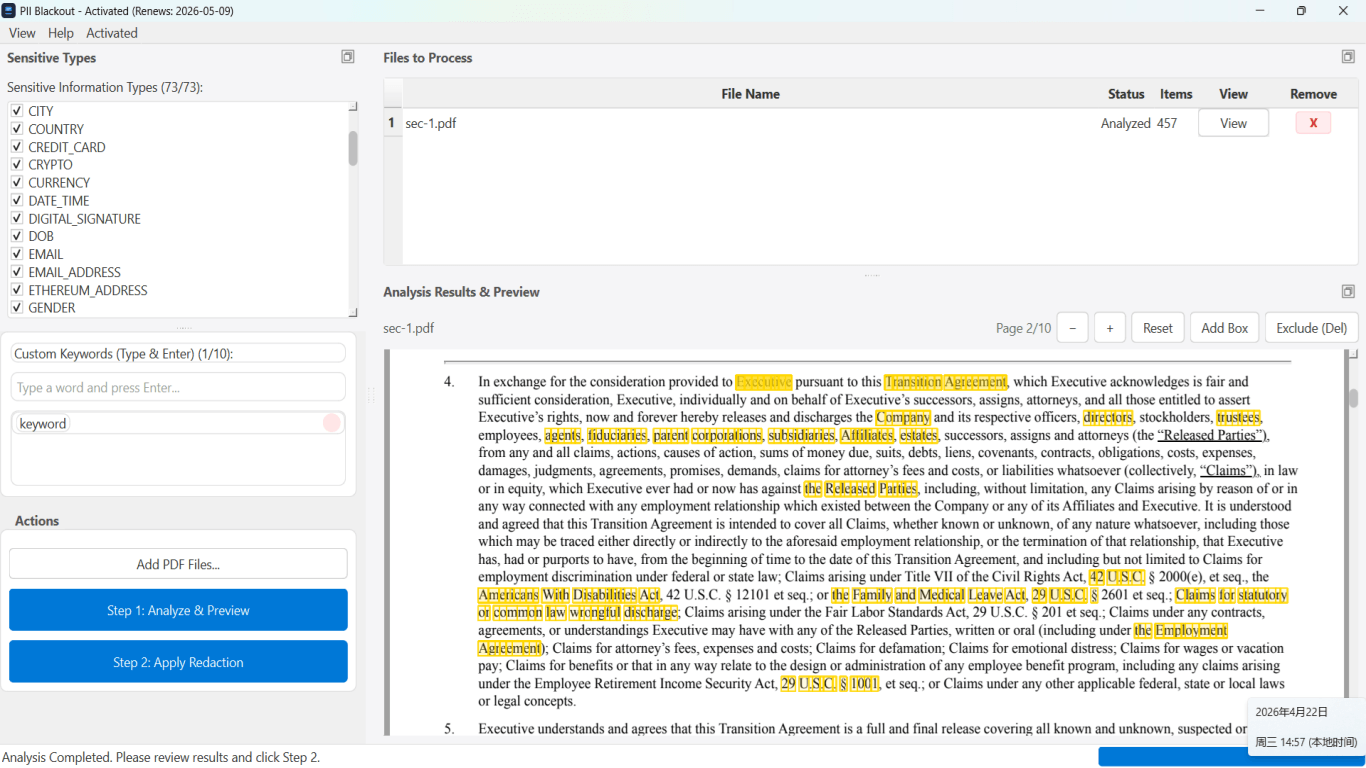
- Run PII detection plus custom keyword Find-and-redact.
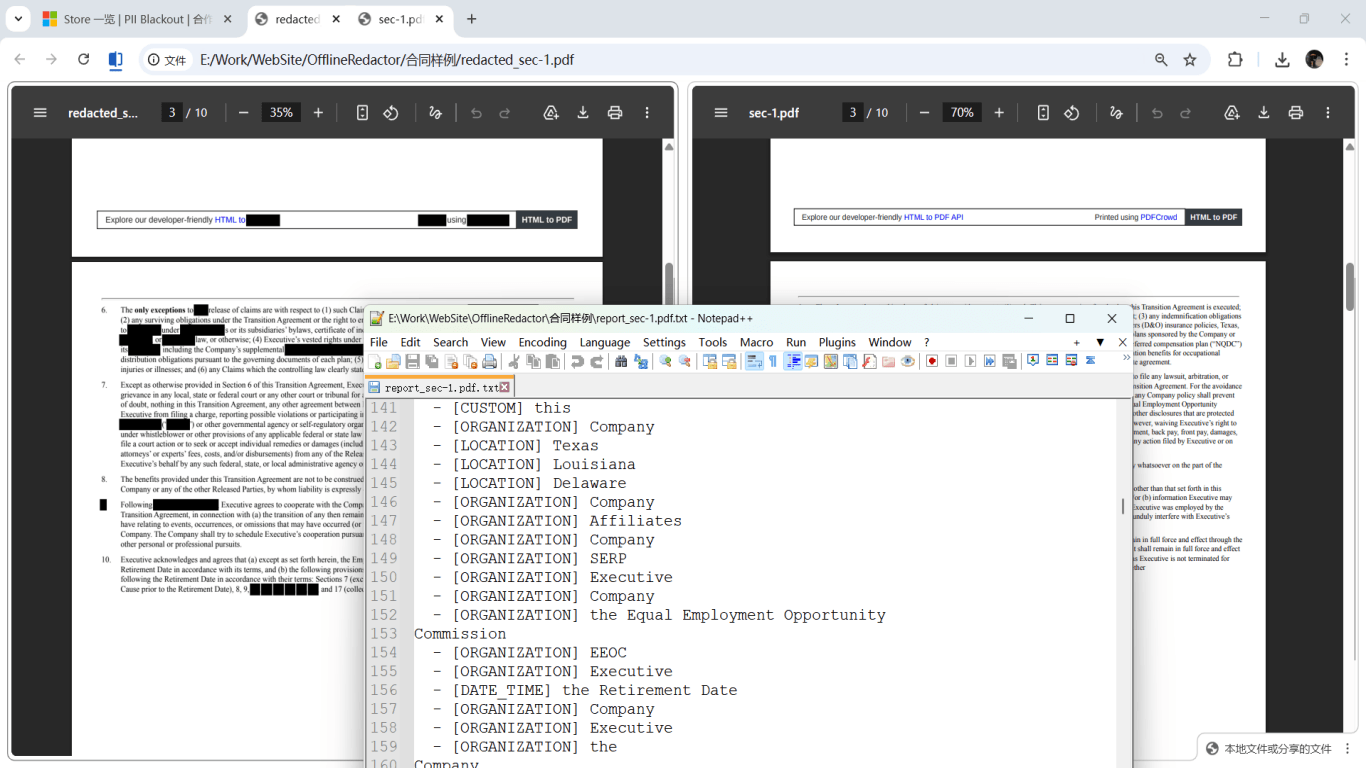
- Review charts, headers, footers, attachments.
- Apply true redaction; sanitize metadata.
- Legal sign-off on recurring template types.
- Log recipient, date, and redaction profile version.
- Deliver via controlled secure transfer.
Step-by-step workflow
- Confirm NDA and legal approval for external share.
- Classify PII vs. business confidential vs. trade secret content.
- Build keyword and customer name search list.
- Export clean PDF from source (no track changes or speaker notes).
- Run detection + manual chart/header review.
- Apply redaction; scrub metadata.
- Legal sign-off; log version ID and recipient.
- Send via controlled channel with expiry/watermark if policy requires.
Common mistakes
- Redacting body but not headers/footers
DMS watermarks often include project codenames and author email.
- Named customers in charts after table redaction
Visual data re-identifies clients—aggregate or redact chart labels.
- Assuming redaction replaces NDA
Unauthorized disclosure remains a breach even if some names were redacted.
- Full dat room to free online tool
Mass exfiltration of company secrets—offline batch only.
Verification before you share
- ✓ Keyword search for project codename and top customer names: zero hits.
- ✓ Chart labels and images reviewed for re-identification.
- ✓ Metadata Title/Author scrubbed.
- ✓ Hidden attachments and comments removed.
- ✓ Legal approval and recipient log complete.
Try the Legal Document template online
Use the Legal Document preset to detect parties, addresses, IDs, and contact fields—without routing numbers that false-positive on fund CUSIPs.
The Legal Document template is pre-selected for this guide. Upload a sample file to see detections, then download the desktop app for confidential batch work.
Redact online — Legal DocumentOffline tool option
For bank statements, legal productions, HR files, and other high-risk PDFs, desktop software that runs offline PII removal lets you auto-detect identifiers, review matches, and apply permanent redaction without uploading to the cloud. PDF redaction hub and Bulk PII redaction helps when you have entire folders—not one file at a time.
Download Free TrialFAQ
Is redaction enough for trade secrets?
No—pair with NDAs, need-to-know access, and legal approval. Redaction reduces content in authorized shares.
Should I redact internal metrics for board advisors?
Follow engagement letter scope—often advisors see full metrics under NDA without public-style redaction.
How do I redact customer names in a PDF report?
Find-and-redact all instances including charts, footnotes, and metadata—not only body paragraphs.